Kandinsky Color Scheme Compositions

The artist Kandinsky was born in Moscow, Russia in 1886.  This date is surprising to most 7th graders since so many associate his non-objective style of painting to be modern looking.  Also surprising, he studied law and economics.  It wasn't until the age of 30 that he began to paint.  He dedicated much of his time painting artworks that drew parallels between visual art and music.
One of Kandinsky's paintings
Kandinsky himself - 7th graders were surprised to find that this suit and tie wearing man was the painter of such abstract art
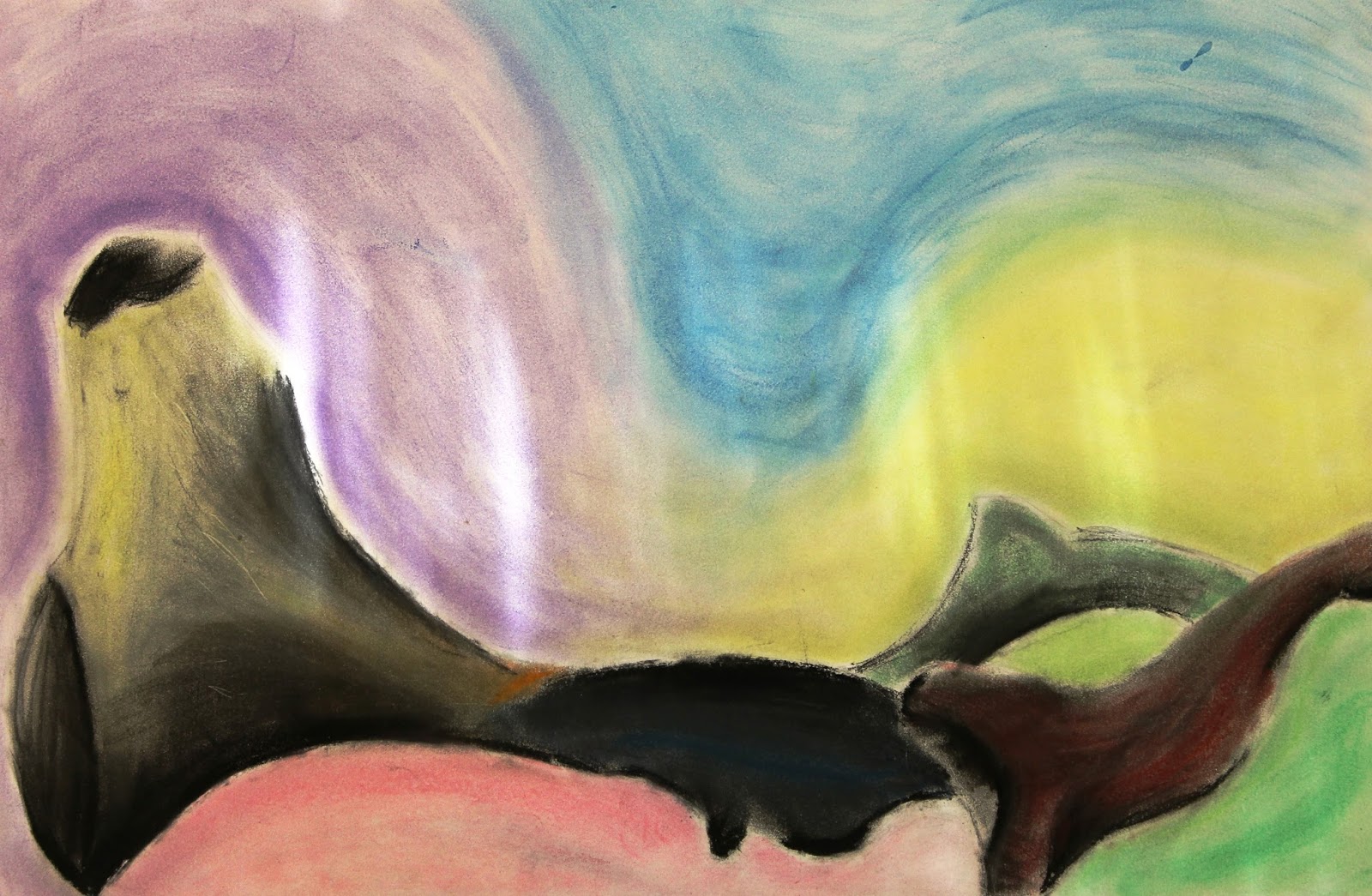
7th graders really took time to make these paintings a success.  Not only did we discuss the great artist Kandinsky but we also explored color, balance and ultimately how to arrange the elements of art to create an interesting composition.  Since music was a focus for Kandinsky we figured out how to show rhythm and movement in designing these beautiful kaleidoscope-like paintings as well.  


Comment?

Getting ready for the new quarter

.... and we're off.  A new quarter is underway.  As I was prepping my room for new beginnings, I decided to take these snapshots.

Turn head sideways (technically difficulties).
 Flagging my pencils with duct tape.


Is your head still sideways?  good, now tilt head to the other side.
Pencils are ready for the borrowing.  Sign out sheet is ready for the writing.


Resume normal head position
Bins labeled with table colors and lights to observe cast shadows

Essential questions posted by grade level.
Comment?

O'Keeffe-scapes

Georgia O’Keeffe was a ground breaking artist in the early – mid 1900’s.

She is best known for her up-close paintings of flowers.  … So close, sometimes, that her subjects tended to look abstract and beautiful in form, value and color.

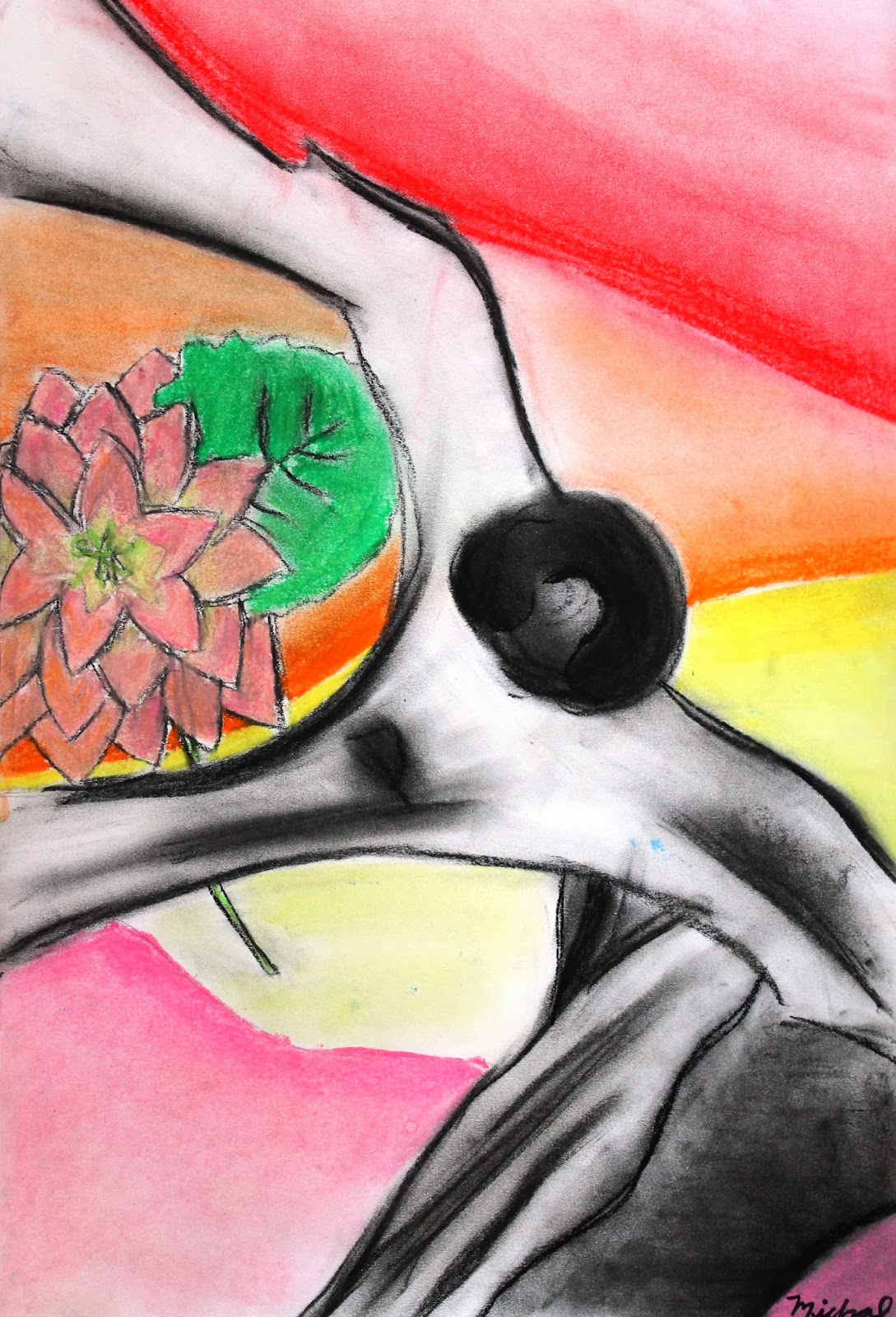
This idea of beauty carried over into anything she made including her paintings of bones.  Bones are not generally thought to be beautiful but O’Keeffe was able to share her perspective with anyone that would take notice to her art work. 
In this project, we observed bones and used a viewfinder to select an interesting composition.  We also did a lot of experimenting with value.  While we warmed up using graphite to create different values, we journeyed to using charcoal (a material that O’Keeffe used in her early art works).  The journey included the discovery of patience + practice = results.  What started as a simple moving line on paper transformed into a 3-dimensional form.  Color was later added in the negative space to add contrast and give the illusion of space. 

 Take a look at all that we did.

 I think 6th graders did fabulous, but it wasn't until I read their artist statements that I discovered what was going on inside those deeply focused heads.  ... and it helps to know that they enjoyed the challenge too.


Comment?

ZENDALAS

I like to begin each quarter relearning the elements and principles of art.  Then we do a project that I consider a playground to experiment with the elements and principles.   

For 6th graders that playground is the Zendala project.  I enjoy this project because it is rich with cultural significance but also dashed with a contemporary twist.  The idea is they are creating a design that is symbolic of themselves.  Every choice they make is a step towards personal expression.  The first decision everyone makes is what type of balance they would like to use - radial, symmetrical, or asymmetrical.  I don't hold back that radial is a challenge for me personally, since it requires such precision; it would drive me crazy.  Although some do enjoy this challenge.  We are all different and this simple fact should be celebrated in everything we do and make. 


Comment?

Personalized Self-Portraits

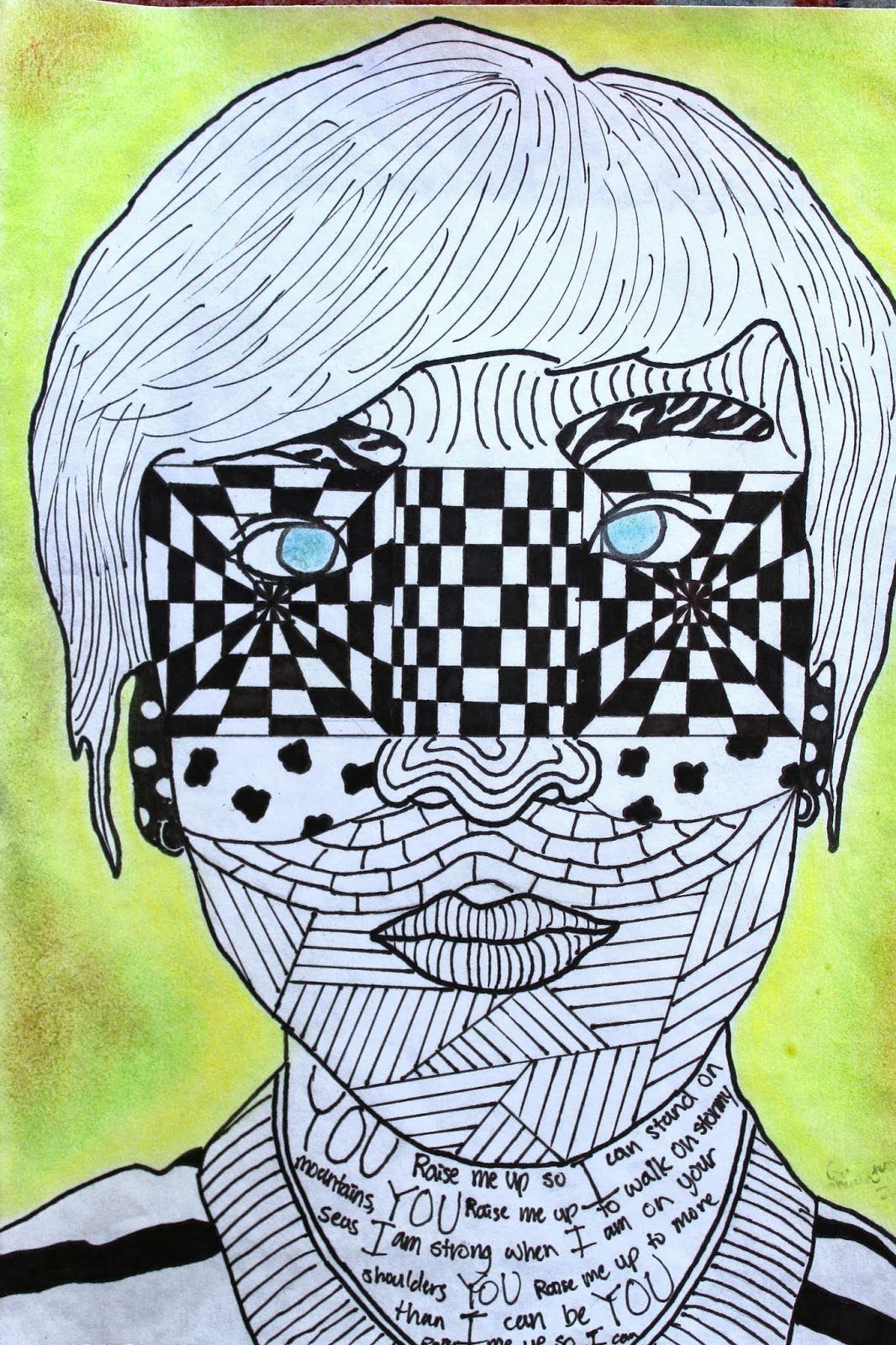
Doodling is not a mindless act.  It is meaningful.  It is an escape from reality, it is inspired by what we see, know, like, and experience.  In fact, many contemporary artists have adopted a doodle-ish approach to their artwork. It is a curious trend??? Gets me thinking - WHY?
 
8th graders collected images of patterns, textures, lines, and symbols, even quotes, lyrics, and other words that have meaning.  All these things we combined to create these personalized self-portraits with a doodle-ish twist.
 
I should mention, contemporary art is not the only focus here. 8th graders also learned something from the great Albrecht Durer.  He was a mathematician and artist credited with “inventing” the grid method.  So, we pulled out our rulers and took lots of measurements, creating a grid that guided us in the drawing these spectacular self-portraits.  I found this a great way to warm up to observation drawing ... really helps the eyes and hands stay in sync. 


Getting started

The first day of class, I wanted to find out what my students' thoughts were about ART.  After going over the syllabus and procedures in the art room (essentially boring them to death).  I gave everyone a post-it note.  I prompted them to complete the sentence, "Art is...."  I left the format open.  They could write a sentence or two, write a poem, draw a picture, ....  I was happy to learn that most felt art was a positive thing.  Perhaps, I will ask the same question at the end of the quarter to see if the responses have changed or become more complex.  We shall see.
A collection of thoughts ... not the best picture but you get the idea

NEW, NEWS

Over the summer, something exciting happend.  I interviewed for a middle school position and, well,.... I am now a MIDDLE SCHOOL ART TEACHER and I am thrilled!